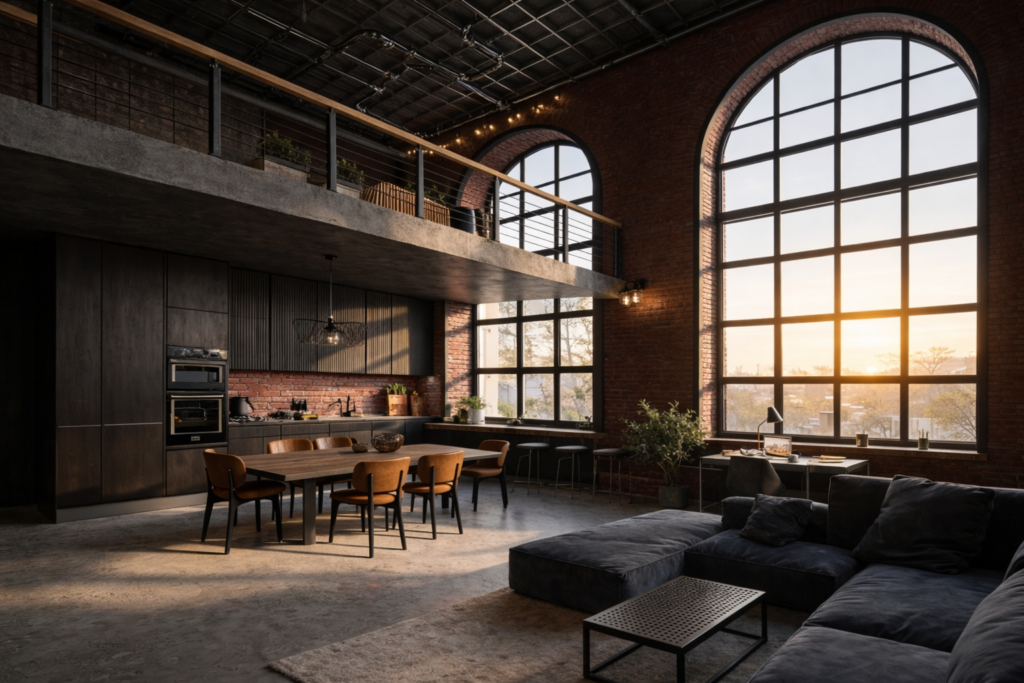
How to Turn a Small Apartment Into a Loft-Style Space
You don’t need a converted warehouse to live like you do. The loft aesthetic is not about square footage — it’s about attitude, material honesty, and the deliberate removal of everything that makes a space feel small.
The loft aesthetic is widely misunderstood as a product of space. It isn’t. The original SoHo lofts were large, yes — but their character came from their material honesty, their restraint, and their refusal to pretend to be something they weren’t. Those qualities translate to any size. What doesn’t translate is trying to make a small apartment look bigger by applying every conventional “small space” trick — mirrors, light colours, multifunctional furniture in beige. That approach produces a space that feels desperately small. The loft approach produces something different.
The loft approach says: this space is what it is. Make it honest. Make it dark. Make it deliberate. A small space designed with that mentality doesn’t feel small — it feels considered. There is a significant difference.
01 — Remove Everything That Isn’t Necessary
Edit First. Add Later.
Before adding a single industrial element, remove. The loft aesthetic is defined by what isn’t there as much as what is. In a small apartment, the accumulation of standard domestic objects — the TV console, the floor rug, the curtain rails, the framed prints arranged in a grid — creates visual noise that fragments the space and makes it feel smaller than it is. Removing half of these objects is the most powerful design intervention available, and it costs nothing.
The Removal List
- Floor rugs — in a small space they fragment the floor plane and make the room feel sectioned. Remove them. If you need warmth underfoot, one small rug under the sofa only.
- Curtains with pelmets or decorative rods — replace with simple roller blinds in linen or black-out, or remove window treatments entirely if privacy allows.
- Gallery walls with many small frames — replace with one large piece or nothing.
- The TV console unit — wall-mount the TV on a black bracket. Remove the unit entirely. The floor space recovered is significant.
- Decorative accessories without purpose — the candles, the vases, the small sculptures. Keep two or three with genuine character. Remove the rest.
- Closed storage units that don’t reach the ceiling — the gap between a low storage unit and the ceiling is dead space that reads as clutter. Replace with open shelving to the ceiling or remove entirely.
02 — Paint the Walls Dark
The Counterintuitive Move That Works
Every conventional small-space guide will tell you to paint walls white or light to make the room feel bigger. Ignore this. Light walls in a small space don’t create space — they create a bright box with clearly visible boundaries. Dark walls — charcoal, deep warm grey, near-black — dissolve those boundaries. The eye can no longer easily locate where the wall surface ends. The room feels undefined in the best possible sense.
For a small apartment, the most effective approach is to paint all four walls and the ceiling the same dark colour. Not one feature wall — everything. When ceiling and walls are the same tone, the vertical boundaries of the room disappear and the space reads as a single atmospheric envelope rather than a series of surfaces enclosing you. This is the spatial logic of the loft, applied at small scale.
Dark walls don’t shrink a small room. They remove its walls from the visual field. That’s the opposite of shrinking.
03 — Treat the Ceiling as a Feature
Make Height Where There Is None
Small apartments typically have standard ceiling heights of 2.4–2.7m. This cannot be changed. But the ceiling’s visual presence can be manipulated dramatically. The standard approach — a white ceiling — creates a hard horizontal boundary that defines the room’s upper limit emphatically. A dark ceiling painted the same colour as the walls removes that boundary. The eye reads upward and finds no endpoint.
- Paint the ceiling the same colour as the walls — the single most effective ceiling intervention. See above.
- Expose any ceiling services you can. If you have the ability to remove a suspended ceiling, do it. Even a few centimetres of genuine height is worth more than any decoration.
- Install pendant lighting that hangs low. A pendant that drops to eye level from a dark ceiling creates a sense of depth above it — the ceiling appears higher than it is because the pendant defines an intermediate level.
- Remove cornice and coving if it is purely decorative. The hard transition line between wall and ceiling emphasises the room’s vertical limits. A continuous dark surface does not.
04 — Choose One Material Statement
One Thing. Done Properly.
In a large loft, you can deploy multiple raw materials simultaneously — concrete floor, exposed brick wall, reclaimed timber table, raw steel shelving. In a small apartment, this approach produces visual overload. The discipline of the small space is to choose one raw material as the defining element and make it exceptional. Everything else supports it.
| Material Choice | How to Feature It | What Supports It |
|---|---|---|
| Raw concrete effect | Microcement on one wall or the floor | Dark paint on other walls, black steel furniture |
| Exposed brick | One wall only, cleaned not painted | Dark walls on remaining three sides, warm lighting |
| Reclaimed wood | Dining table or full-height shelving unit | Dark paint, black steel legs/brackets, concrete floor |
| Black steel | Window frames, shelving, furniture legs | Dark walls, one warm material (leather or wood) |
05 — Furniture: Less, Lower, Better
Scale and Restraint
The loft approach to furniture in a small space is the opposite of the multifunctional-furniture approach. Where conventional small-space design tries to do more with less floor space, the loft approach does less with the floor space and uses that restraint to create a sense of volume. Fewer pieces. Lower profiles. Larger individual pieces rather than many small ones.
- One large sofa instead of a sofa plus armchair. A single 240cm sofa fills the space with intention. A sofa plus two armchairs fills it with furniture.
- Low-profile everything. Sofa seat height under 42cm, coffee table under 35cm, bed frame under 30cm from floor. Low furniture makes the ceiling appear higher by contrast.
- Visible floor. The floor is the largest surface in the room. The more of it that is visible, the larger the room feels. Every piece of furniture that clears the floor on legs contributes. Skirted or ground-level furniture removes the floor from the visual field.
- One dining table and nothing else in the dining area. No sideboard, no display unit. The table and chairs, full stop.
06 — Lighting: Warm, Layered, Dimmable
The Layer That Changes Everything
In a dark, small apartment, lighting is not decoration — it’s the spatial layer that makes the entire approach work. Without the right lighting, a dark small apartment is simply dark and small. With it, it becomes atmospheric and deliberately considered. The distinction between the two is entirely in the lighting decisions.
- Never rely on a single overhead light. One ceiling fixture lit at full brightness creates even illumination — which reads every surface equally and emphasises the room’s limits. Layer instead: a pendant over the dining area, a floor lamp by the sofa, a wall sconce in the bedroom.
- All bulbs at 2200–2700K maximum. Warm white only. Cool white light in a dark room is clinical and oppressive. Warm amber light in a dark room is the loft aesthetic made manifest.
- Dimmers on every circuit. A small apartment with dimmable lighting can be transformed from a bright, functional daytime space to a low-lit, atmospheric evening space. The same room reads completely differently at 30% light level.
- Use uplighting to make ceilings disappear. A floor lamp aimed at the ceiling or a wall, or a candle on a low surface, draws the eye upward and creates perceived height.
The Principle Underneath All of It
The loft aesthetic, applied to a small apartment, is ultimately about accepting the space for what it is and making every decision with that acceptance as the starting point. Not fighting smallness with artificial enlargement tricks. Not pretending the apartment has high ceilings or raw concrete floors if it doesn’t. Instead: dark walls that remove the sense of a bounding box. One raw material used exceptionally. Minimal, low, considered furniture. Warm, layered, dimmable light.
These principles don’t make a small apartment look like a large loft. They make it look like a small apartment that knows exactly what it is. That is a far more desirable outcome.
The loft aesthetic is not about space. It’s about intention. A 40m² apartment with intention reads better than a 200m² loft without it.