Should You Paint a Wall Black? (Yes — Here’s How)
The fear of black walls is almost universal — and almost always unjustified. Black doesn’t make rooms smaller. It makes them deeper. Here’s everything you need to know before you open the tin.
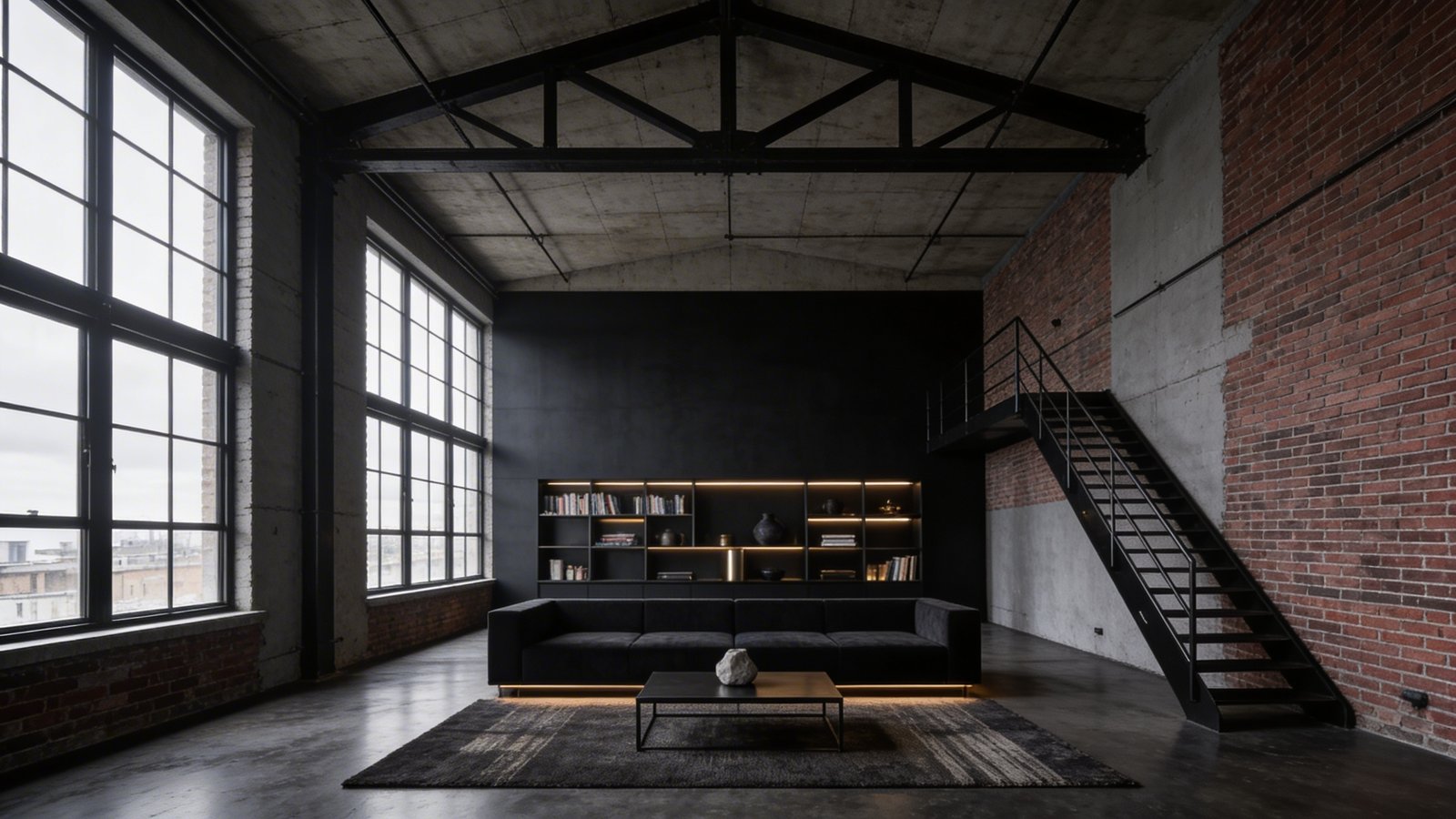
Black walls make most people nervous. There is a deeply conditioned belief — reinforced by every mainstream interiors guide ever written — that dark colours shrink rooms, absorb light, and create oppressive spaces. This belief is wrong. Not partially wrong. Fundamentally, demonstrably wrong.
Black walls don’t make rooms smaller. They remove the walls from the visual field entirely. When a wall is painted the same off-white as the ceiling and skirting, it remains stubbornly present — a flat, bounding surface that reminds you at every glance of the room’s dimensions. Paint it black and the wall dissolves. The space between objects becomes the room. This is not a trick. It’s a fundamental shift in how the eye reads space.
01 — Which Wall to Paint
Placement is Everything
The single most important decision in a black wall project is not the paint colour — it’s which wall you paint. In most rooms, only one wall can carry black without making the space feel claustrophobic. Choose incorrectly and the result is a cave. Choose well and the result is a room with a gravitational centre.
The Right Wall
- The wall you face first when entering the room. This creates immediate drama and draws you in — the classic use of a black feature wall.
- The wall behind the bed. In a bedroom, the headboard wall in black grounds the entire room. Everything else — linen, pillows, side tables — is framed against it.
- The wall that terminates a corridor. A narrow corridor with a black end wall becomes a deliberate vista rather than a forgotten transition.
- The wall with the fireplace or architectural feature. Black amplifies the weight of a chimney breast or alcove without adding visual clutter.
The Wrong Wall
- A wall with no natural light opposite it. Without light to create contrast, a black wall in deep shadow reads as flat and heavy.
- The wall adjacent to a small window. This compounds the lack of light and shrinks the visual field rather than expanding it.
- All four walls simultaneously — unless the room has exceptional ceiling height, volume, and dramatic lighting. Even then, proceed carefully.
02 — Choosing the Right Black
Not All Blacks Are Equal
This is where most black wall projects fail before they begin. There is no such thing as “black paint.” There are dozens of distinct blacks, each with different undertones that become dramatically visible on a large wall surface. A black with green undertones looks deeply unpleasant next to warm wood. A black with blue undertones reads cool and slightly clinical. A warm black with brown undertones does the opposite — it anchors, it warms, it recedes.
| Paint | Brand | Undertone | Best For |
|---|---|---|---|
| Railings | Farrow & Ball | Warm, slightly brown | Industrial lofts, warm palettes |
| Pitch Black | Farrow & Ball | Pure, near-neutral | Maximum drama, cool spaces |
| Studio Green | Farrow & Ball | Deep green-black | Rooms with natural light |
| Ebony | Little Greene | Warm, dark brown-black | Wooden furniture pairings |
| Abyss | Mylands | Cool, deep blue-black | Modern industrial, steel spaces |
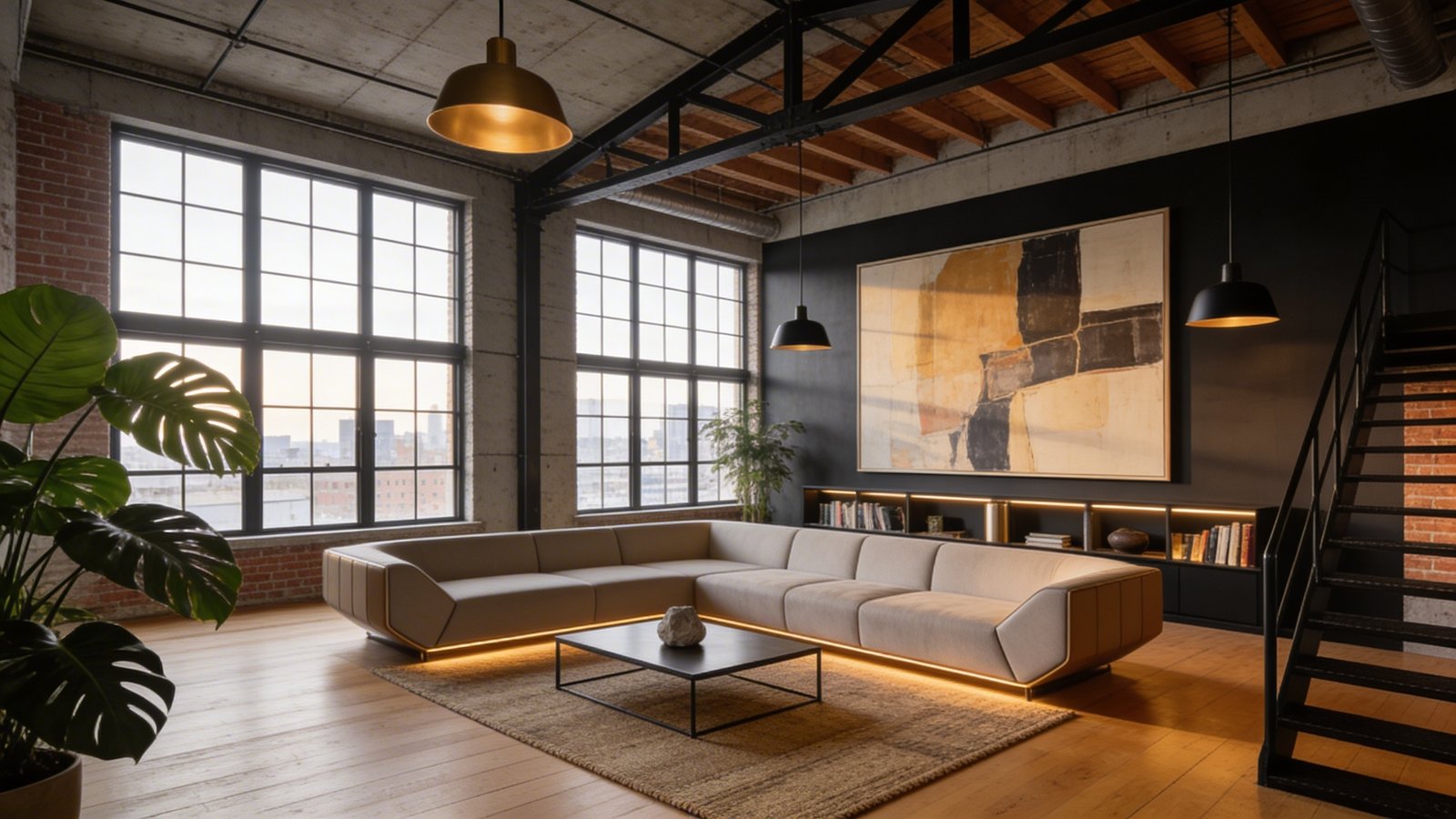
For an industrial loft with copper accents and warm wood, always choose a warm black with brown undertones. Never a green-black. Never a blue-black unless the palette is deliberately cool throughout.
03 — The Finish Matters as Much as the Colour
Matte, Eggshell, or Satin
The sheen level of a black wall changes its character entirely. A high-gloss black wall reads as lacquered — glamorous, bold, but not industrial. A matte black wall absorbs light and produces the deep, atmospheric quality that industrial interiors require. An eggshell finish sits between the two — easier to clean, with a very subtle sheen that adds just enough life to the surface without making it reflective.
- Dead flat matte — the most atmospheric. Shows every imperfection in the wall. Use only on well-prepared surfaces.
- Eggshell — the recommended finish for most rooms. Slightly wipeable, minimal sheen, looks exceptional under warm light.
- Satin — for high-traffic walls, kitchens, and rooms that need regular cleaning. Slight reflectivity acceptable if the lighting is warm.
- Gloss — avoid in an industrial context. Creates a mirror quality that contradicts the rawness of the aesthetic.
04 — How to Apply It Correctly
Preparation & Technique
Black paint is unforgiving. Every imperfection in a wall surface — every crack, patch, roller mark, and brush stroke — is visible under a dark colour in a way that off-white and neutral tones simply mask. Preparation is not optional. It is the project.
Step by Step
- Fill every crack and hole. Use flexible filler for plaster cracks. Sand smooth when dry. Even small imperfections read dramatically under black.
- Sand the entire wall surface. Lightly sand to give the paint something to grip and to level any previous roller texture.
- Apply a grey primer. Dark paints need a primer that matches their depth. A white primer requires 4–5 coats of black to achieve full coverage. A mid-grey primer achieves the same result in 2–3 coats.
- Use a high-quality roller. A short-nap (6mm) roller produces the smoothest finish on interior walls. A cheap roller leaves bubbles and an uneven surface that is unacceptable under dark paint.
- Apply in long, consistent strokes. Work in W or M patterns to ensure even coverage. Don’t go back over wet paint — wait for each coat to dry completely.
- Three coats minimum. Two coats of black over grey primer usually achieves full coverage. Three coats guarantee it. Rushing produces uneven opacity that reads poorly under raking light.
05 — What Goes On the Black Wall
Objects, Lighting, Hardware
A black wall is not a backdrop. It is an active element of the room’s composition. What you place on it — or choose not to place on it — determines whether the wall becomes the room’s defining feature or its most expensive mistake.
What Works
- Copper or brass hardware. Wall hooks, picture lights, shelf brackets — warm metals against black are the defining combination of the Urban Depth aesthetic.
- A single large-scale artwork or photograph. One well-chosen piece at full scale. Not a gallery wall — one thing, given the space to breathe.
- Reclaimed wood floating shelves. The warm grain of aged wood against a black wall is one of the most effective material pairings in industrial design.
- A wall-mounted articulated lamp. An industrial sconce on a black wall creates a composition — the lamp’s form is silhouetted and becomes architectural.
- Nothing at all. A completely bare black wall, lit well, is often the most powerful choice. Resist the urge to fill it.
What Doesn’t Work
- Gallery walls with many small frames — creates noise rather than composition
- White or very light objects — the high contrast reads as jarring, not intentional
- Chrome or polished silver hardware — cold metals conflict with a warm black
- Busy wallpaper or texture panels placed adjacent — the wall needs quiet surroundings to work
06 — The Lighting Requirement
A black wall without the right lighting is a failed black wall. This cannot be stressed enough. Black surfaces absorb light — which means they require significantly more of it, placed with far more precision, than a light-coloured wall. The most common failure of a black wall project is not the paint choice. It’s inadequate lighting.
- Always use warm light (max 2700K) on a black wall. Cool white light on black produces a cold, flat effect that destroys the atmosphere entirely.
- Raking light reveals texture. A spotlight positioned close to the wall and aimed at an angle grazes the surface and reveals any texture in the paint or plaster — making it beautiful rather than just dark.
- Put every light source on a dimmer. A black wall at 100% overhead light looks different — and worse — than the same wall at 40% with warm directional lighting.
- Never rely solely on overhead lighting. One ceiling fixture is not enough. Layer: a floor lamp, a wall sconce, a candle on the surface in front of it.
The paint is 30% of the project. The lighting is 70%. Get the lighting wrong and no amount of effort spent choosing the perfect warm black will save it.
Yes. Paint the Wall Black.
The question at the top of this article has a simple answer: yes. Paint the wall black. Choose a warm-undertoned black, apply it in matte or eggshell to a properly prepared surface, place the right objects on it, and light it with warm, directional, dimmable sources. The result will be the most compelling surface in your home — and the decision you’ll wonder why it took you so long to make.