Industrial Lighting Guide: The Only Fixtures You Actually Need
There are thousands of industrial-style light fixtures on the market. Most of them are wrong. This is the definitive list of what actually works — and why.
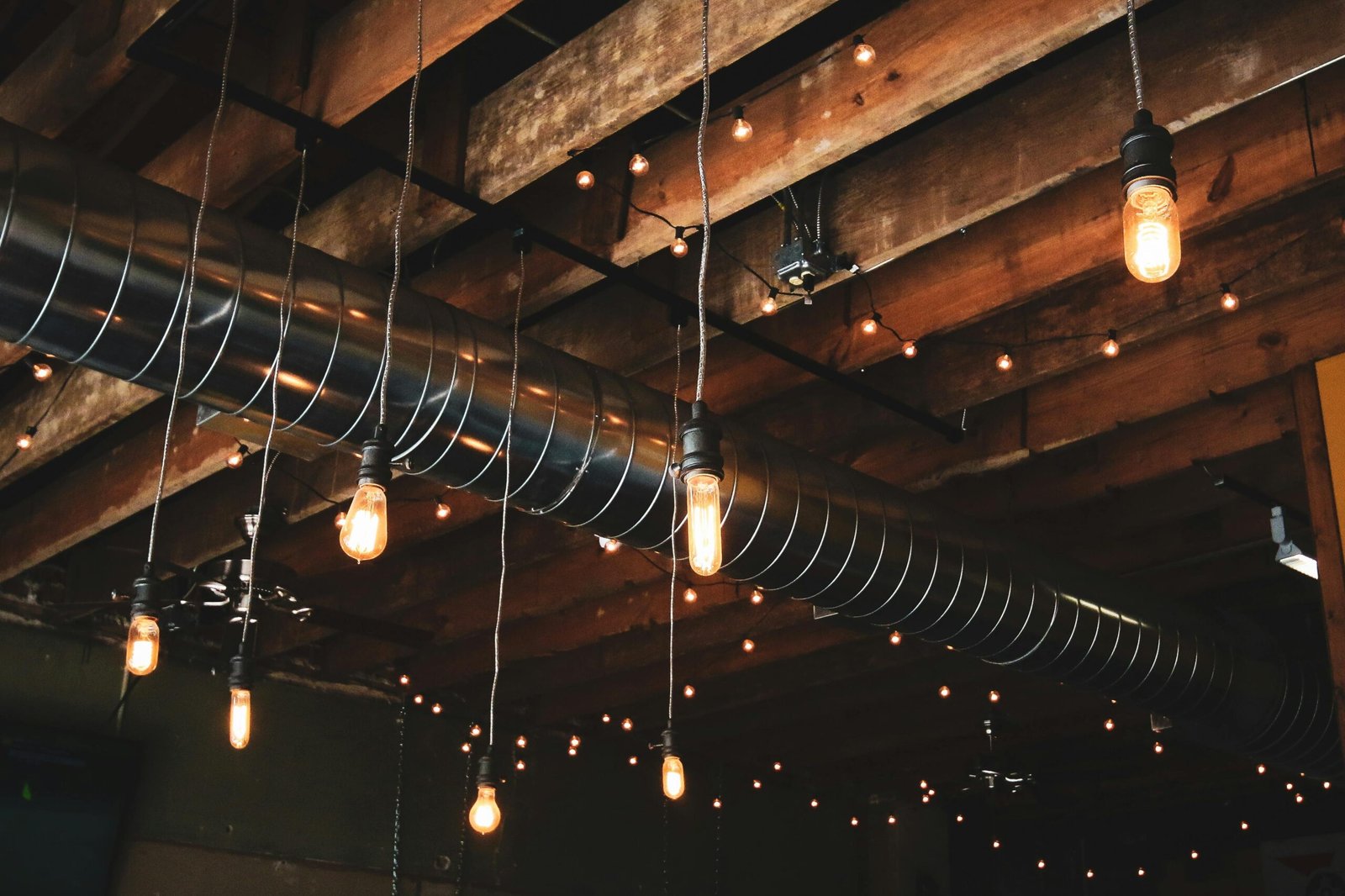
The lighting market for industrial interiors is oversaturated and under-considered. Every online retailer offers cage pendants, Edison bulbs, and pipe-mounted fittings — but the majority are decorative props rather than genuine lighting tools. They borrow the visual language of industrial lighting without understanding what industrial lighting is actually for.
This guide covers only fixtures that perform as well as they look. Six categories, each essential. Each with specific recommendations on placement, height, colour temperature, and what to avoid.
Before You Buy Anything: The Kelvin Rule
Every fixture in an industrial loft should use bulbs between 1800K and 2700K. This is not a preference — it is a rule. Anything above 3000K produces a cool, clinical quality that destroys the atmosphere that industrial design depends on. The warmth of raw materials — brick, steel, leather, wood — only emerges under warm light.
| Kelvin Range | Quality | For Industrial? |
|---|---|---|
| 1800–2200K | Deep amber, candlelight quality | ✓ Ideal for accent lighting |
| 2200–2700K | Warm white, classic incandescent | ✓ Best all-round choice |
| 2700–3000K | Soft white, slightly cool | ⚠ Acceptable only |
| 3000K+ | Neutral to cool white | ✗ Avoid entirely |
Fixture 01 — The Cage Pendant
The Foundational Fixture
The cage pendant is the definitive industrial light fixture — a wire or metal cage surrounding a bare socket and exposed bulb, suspended on heavy chain or industrial conduit. It reads as both functional and sculptural: you see exactly what it is and exactly what it does.
Placement & Specs
- Height over dining table: 70–80cm from tabletop to base of fixture
- Height over kitchen island: 60–75cm from surface
- In clusters: vary heights by 15–25cm between pendants for depth
- Bulb: Edison filament, 40W equivalent, 2200K maximum
- Finish: matte black, aged bronze, or raw iron only — never chrome
Avoid cage pendants with visible plastic components or polished chrome finish. The exposed bulb is the point — never hide it behind an opaque shade.
Fixture 02 — The Industrial Track
Flexible Ambient Control
Track lighting mounted on exposed conduit or a simple steel rail is the most flexible ambient lighting solution for a loft. Unlike recessed downlights — which commit to fixed positions and can’t adapt to furniture changes — a track system lets you direct light exactly where you need it, and redirect it as the space evolves.
How to Use Track Lighting in a Loft
- Aim at walls, not floors. Washing a brick or concrete wall with directed light creates depth and texture. Pointing tracks straight down produces flat, even illumination — the enemy of atmosphere.
- Use to define zones. A track positioned over the kitchen area anchors that zone without a single partition wall.
- Always pair with dimmers. Track spots at 100% are functional. At 20–40%, they become atmospheric.
- Choose consistent heads. A mix of track head styles on a single rail looks indecisive. Pick one family and stay with it.
Fixture 03 — The Articulated Wall Sconce
Precision & Functionality
The articulated wall sconce — mounted on a pivoting arm that can extend, retract, and angle — is the most useful single light in a loft bedroom or reading zone. It brings the light source close to where it’s needed without occupying floor space, and its visible mechanics are inherently industrial.
Where to Place It
- Either side of the bed — replaces bedside lamps, frees up surface space
- Beside a reading chair — gives precise directional reading light
- In a home office — position above desk at 45° angle for glare-free task light
- At corridor end walls — creates a focal point and terminates the visual line
Fixture 04 — The Floor Uplight
Depth Through Uplighting
The floor uplight is the most underused lighting tool in a loft — and one of the most powerful. Positioned at the base of a brick wall, behind a sofa, or beneath a large plant, it throws light upward across rough surfaces, creating textural shadows that no other light source can produce. The ceiling disappears; the wall becomes the feature.
A single floor uplight behind a sofa, aimed at a concrete wall at 2200K, does more for a room’s atmosphere than any number of overhead fixtures. It makes the wall glow. It makes the ceiling vanish. It makes the space feel alive.
Fixture 05 — The Oversized Factory Pendant
The Statement Piece
The oversized factory pendant — a large dome shade, originally designed to direct light downward in industrial work environments — is the statement fixture of modern industrial design. At 40–50cm diameter, hung low over a dining table or kitchen island, it defines the zone beneath it with absolute authority.
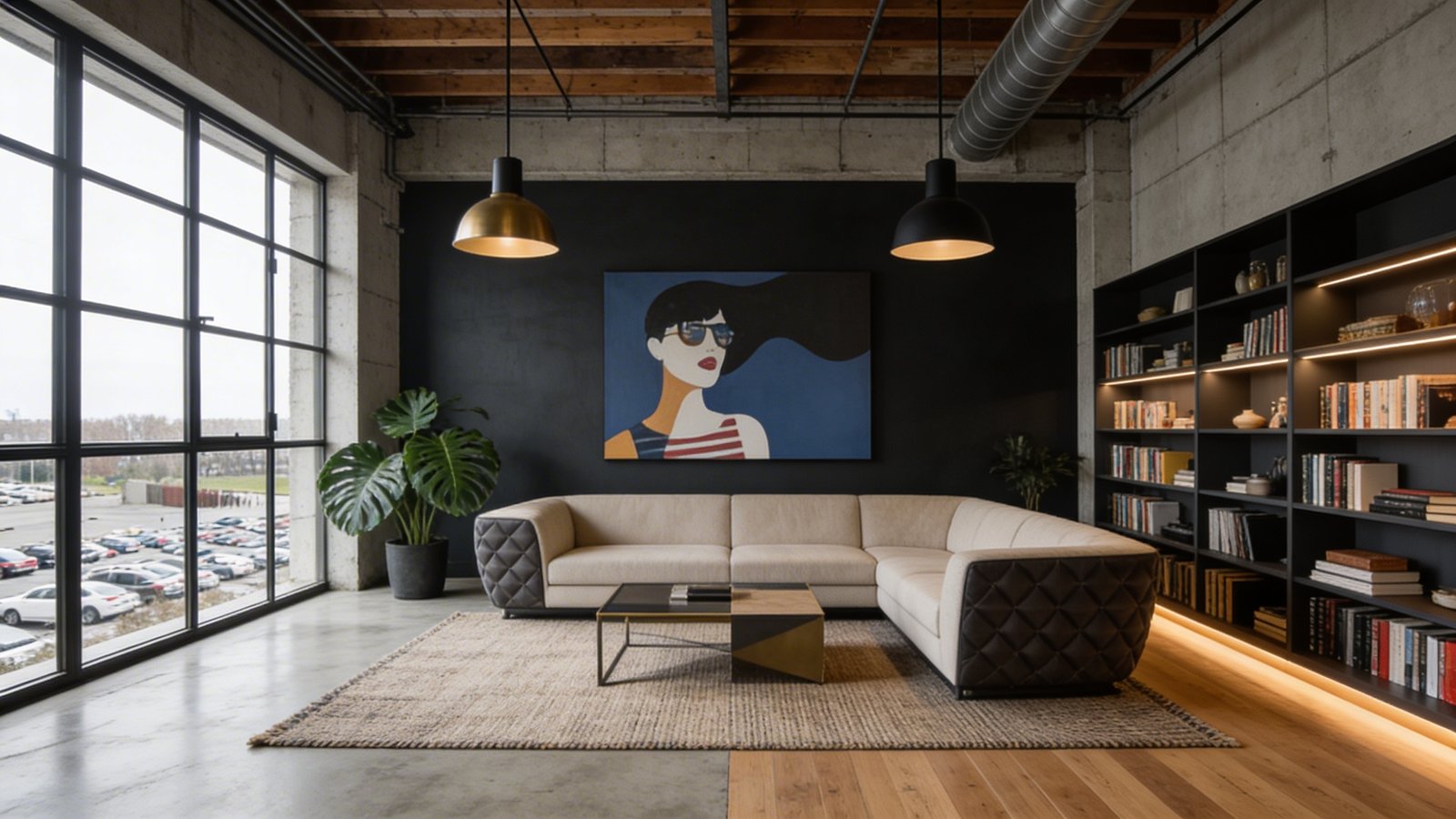
Sizing Guide
- Small table (4 people): Single pendant, 40cm dome
- Medium table (6 people): Two pendants, 35cm each
- Large table (8+ people): Three pendants in a row, 30cm each
- Kitchen island: Two pendants at equal spacing, 30–35cm
- Hanging height: always 70cm from tabletop to base of shade
Fixture 06 — The Carbon Filament Cluster
The Installation Piece
A cluster of bare carbon filament bulbs hanging at different heights from a ceiling rose is simultaneously the simplest and most architectural lighting installation possible. Five to nine bulbs, varied drop lengths, the same socket style throughout — the visible filaments glow in amber at 1800–2000K, creating a sculptural presence that no shade or fitting can match.
What to Avoid: Fixtures That Kill the Atmosphere
- Recessed downlights across the full ceiling. Flat, even light with zero shadow. The single most effective way to destroy loft atmosphere.
- LED strip lighting behind furniture or under shelves. Overused, produces a blue-ish halo, and reads as a shortcut rather than a decision.
- Polished chrome or brushed steel fixtures. Cold metals in a warm material environment create immediate visual dissonance. Black, bronze, or aged brass only.
- Plastic cage pendants. The visual language is right but the material is wrong. Real industrial cage pendants are metal, heavy, and cold to the touch.
- Cool white bulbs (above 3000K). No industrial fixture can compensate for cool white light. The bulb temperature overrides everything.
These six fixture categories are sufficient for any loft. You do not need more types — you need more precision in how you use these. A space lit exclusively with cage pendants, track spots, and one floor uplight, all at 2200–2700K and on dimmers, will outperform any space with a dozen different light sources that haven’t been chosen with this degree of intention.
You don’t need more light sources. You need more precision with fewer of them.